| ♦ Board of Directors ♦ |
| ♦ Collecting Policy ♦ |
| ♦ Core Documents ♦ |
| ♦ Internships ♦ |
| ♦ Alamo Theatre Renovations ♦ |
| ♦ NHF History ♦ |
| ♦ FAQs ♦ |
The purpose of Northeast Historic Film is to collect, preserve, and make available to the public, film and videotape of interest to the people of northern New England.
Activities include, but are not limited to, a survey of moving pictures of northern New England; preserving and safeguarding film and videotape through restoration, duplication, and climate-controlled storage; the creation of educational programs through screenings and exhibitions on-site and in touring programs; assistance to members of the public, scholars and students at all levels, and members of the film and video production community.
- Northeast Historic Film (NHF) is a tax-exempt nonprofit organization founded in 1986.
- NHF has a large and growing collection of unique moving-image materials relating to the history and culture of northern New England.
- The organization is recognized for working with a community of citizens locally, regionally, and throughout North America, who care for this historical resource and are committed to developing its use and support.
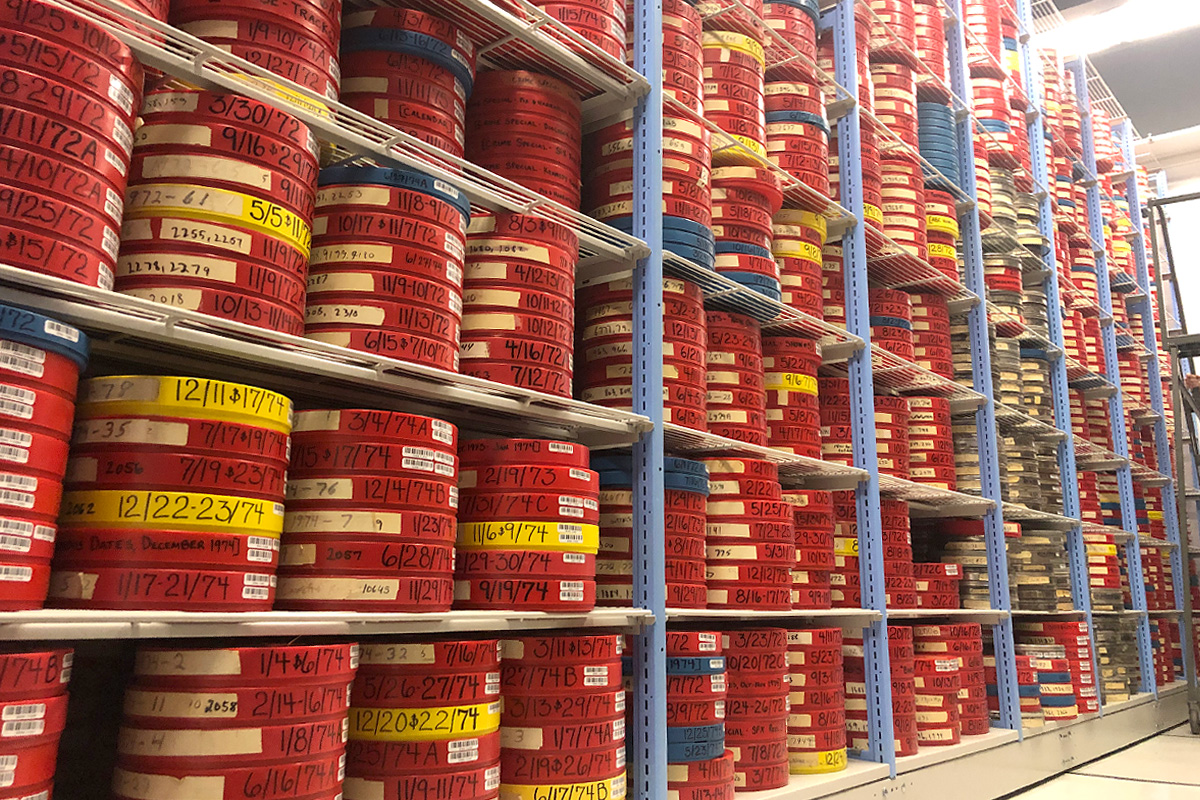
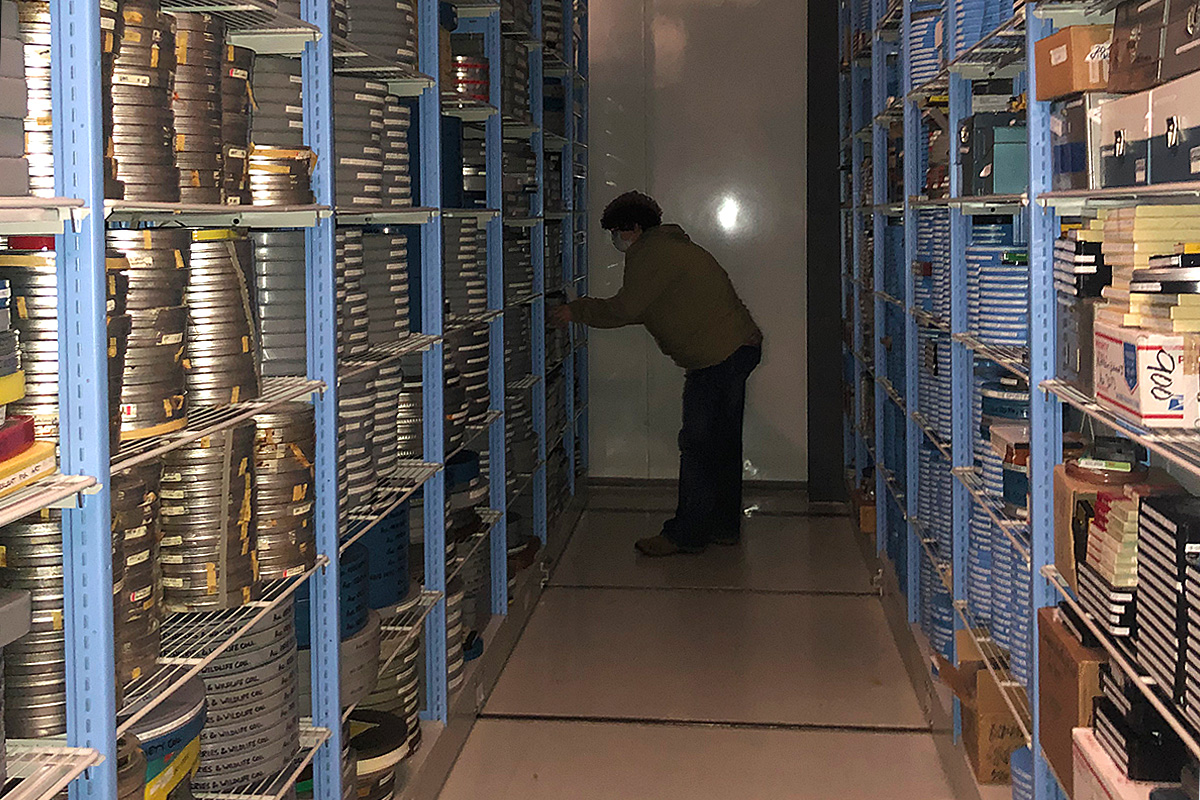
- In 2003 Northeast Historic Film opened a Conservation Center to extend the life of its film and video collections by providing temperature- and humidity-controlled storage in a secure facility. Space in the Conservation Center is also occupied by the collections of Archival Storage Consortium partners, and is also available for rent by organizations and individuals.
The Board of Directors of Northeast Historic Film consists of 9 people. The bylaws allow for as few as three (which is where NHF started in 1986), and as many as 15 board members, each elected for a three-year term. The Board holds three meetings a year, usually two in Bucksport and third at another location, with additional committee meetings as needed.
Sian Evans
Belfast, Maine
Consulting Producer for documentaries on science, nature and history including Discovery HD Theater, National Geographic, PBS. Twenty-six years of experience, working nationally and internationally. Family roots in Kingman, Macwahoc, and Millinocket, Maine.
Paul Gelardi
Treasurer
Cape Porpoise, Maine
President, E Media, Kennebunk, a process development company specializing in plastic manufacturing and surface technologies.
James S. Henderson
Vice President
Harpswell, Maine
Principal, Publius Research, a public affairs consulting firm. Author of Maine: An Encyclopedia, a DVD incoprorating moving images. Ph.D. in political science from Emory University. Adjunct faculty member, Southern New Hampshire University. Director of the Maine State Archives, 1987-2007.
Judith F. McGeorge
Ellsworth, Maine
Background in banking and finance. Served as Executive Director and board member of organizations including the Bagaduce Music Lending Library, the Seymour Papert Institute, and WERU community radio. Advisor on the Hacock County Fund of hte Maine Community Foundation.
James A. Phillips
Bangor, Maine
Co-founder of Trio Software Corporation, and an independent property assessment consultant. Former staff producer and director at WMTW TV; studied film at George Eastman House.
Richard Rosen
President
Bucksport, Maine
Owner Rosen's Department Store, Bucksport. Maine State Senator, member of Health & Human Services Committee. Former State Representative. Board member, Bucksport Regional Health Center.
Karan Sheldon
Secretary
Milton, Massachusetts
Board member, Association of Moving Image Archivists and Trustee, Milton Academy.
David S. Weiss
Blue Hill Falls, Maine
Executive Director and co-founder of Northeast Historic Film. Previously media producer in
Boston after graduating in film and semiotics from Brown University. Member, Maine Historical
Records Advisory Board.
Pamela Wintle
Washington, D.C.
Founder, Smithsonian Institution Human Studies Film Archives. Member, National Film Preservation Board. Founding chair, Association of Moving Image Archivists' amateur film group, Inédits. Family roots in Skowhegan, Maine.
Much of the film and video brought to NHF relates to northern New England. But other moving image material also reaches our door, including dramas, newsreels, animated shorts, and comedies. NHF's primary goal is preservation, and will work to find the appropriate home for material that may not be related to the region.
Acquisition and accessioning of films, videos, and related materials at NHF shall proceed according to criteria which are intended to maximize usefulness through preservation and for research purposes.
High priority is given to moving images with the following characteristics, although these measures will not be mechanically applied in determining whether or not to accept the material:
- Related to the northern New England region through location, subject, maker, source or other connection.
- Unique, or inaccessible to the northern New England population.
- Otherwise likely to be damaged or lost.
- As close to the original film or tape generation as possible and is of good picture quality.
- Well-documented, and where possible accompanied by related non-motion picture references such as notes, still photographs, audiotapes.
Moving images meeting many of these criteria will generally have high priority for acceptance, while those meeting few or none will have lower priority. Materials preserved elsewhere, widely distributed, or requiring severely restrictive donation conditions are considered low priority.
NHF also collects and preserves objects and ephemera that relate directly to individual moving-image collections, including notes, still photographs and audiotapes. Such objects can also include promotional materials for individual items or creators such as posters, press books, biographical publications, and correspondence.
NHF will collect and preserve selected items of ephemera relating to New England films, with special attention to films that are "lost." This area of collecting supports the NHF Mission Statement goal of creating a survey of moving pictures of northern New England.
NHF will collect posters from the silent era, and all post-1920 posters of films with a New England connection, as well as ephemera relating to film exhibition and the history of movie theaters and their audiences in northern New England. These materials include business records and correspondence, programs, postcards, posters and lobby cards, lantern slides, photographs, and other images.
The primary collecting focus is on northern New England, but since so many aspects of film exhibition and audience practices were similar throughout the nation, broader collections such as a postcard-image collection of theaters from across the country would strengthen NHF collections by showing similarities and contrasts. This rationale, that national and international references provide contextual data, supports the acquisition of carefully selected national trade periodicals.
An internship at Northeast Historic Film provides an individual with the opportunity to build on existing archival skills through specific projects related to the collections. Internships are intensive and require extreme attention to detail and the ability to work independently.
A background in museum or archival studies, a strong work ethic, and attention to detail are all essential. Basic film knowledge and a background in motion picture film preservation are also required in order to work with the motion picture collections. Basic knowledge of Word and Photoshop may also be necessary depending on the area of focus.
An internship will generally focus on one of the areas listed below, and will center on a specific project related to the material in that area. Other duties may also be assigned.
Moving Image Collections
An internship working with the film and video collection will entail film collection management and maintenance. Basic film inspection and cataloging skills are required along with a background in film preservation and film handling. Tasks may involve collection inspections, recanning collections, conducting vault inventories, labeling cans, film transfers, and data entry.
Ephemera and Technology Collection
A project in this area will typically involve conducting inventories of the periodical and/or ephemera holdings, cataloging holdings of amateur filmmaking equipment, providing item-level collection descriptions and updating database records.
Photograph Collection
Projects will typically involve identifying, cataloging and inventorying photographs, and updating database records with descriptive information. Additional projects may involve scanning and rehousing photographic materials.
Internships are unpaid and require a minimum of 30 hours a week of work. An internship must last a minimum of 4 weeks, and a maximum of 12. Up to 3 internships are available each summer, one in each area listed above. Past interns have come from the New York University Moving Image Archiving and Preservation program, the Peary-MacMillan Arctic Museum, the Rhode Island School of Design, and the University of Maine, among others.
Application Procedure
Be certain to describe an area of interest and goals of internship. Applications must be received by the first week of May.
Send a cover letter and resume to:
Internships
Northeast Historic Film
PO Box 900
85 Main Street
Bucksport, ME 04416
The Alamo Theatre was a shell of its former self when NHF purchased it in 1992. Work on the building began shortly afterwards and continues today.

Interior of the Alamo, 1993.
photo by Alan McClelland
Extensive renovations were required to make the Alamo Theatre building a structure capable of supporting the needs of Northeast Historic Film. The original interior of the building was gutted in 1956 to make way for an A&P supermarket, and one of NHF's first goals for the building was to return community movie-going to the area. The W.K. Kellogg Foundation made a grant of $20,000 to assist with the initial renovations, which involved digging down to the ground and removing 60 truckloads of earth to install a new drainage system.
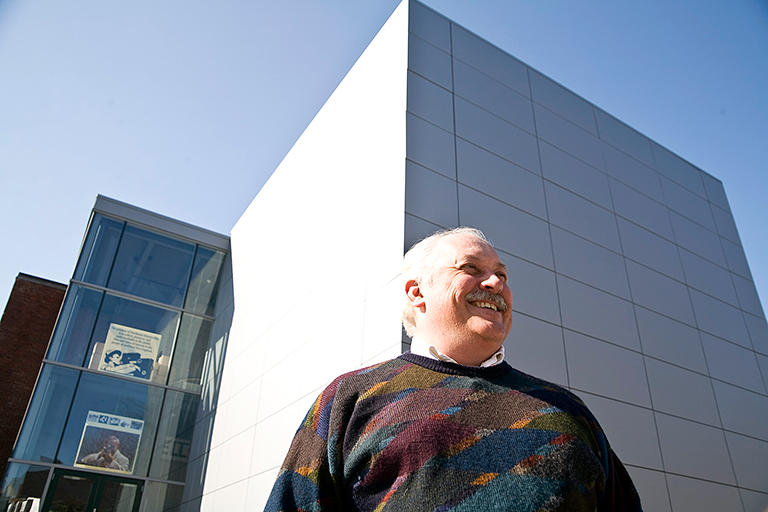
NHF's next major undertaking was the Conservation Center. Also referred to as "The Cube," this building is the first of its kind in the Northeast and one of only a handful nationwide. The construction drawings were executed by John Gordon of Bucksport, the architect of record, based on a conceptual design by architect Terry Rankine. Groundbreaking for the $1.8 million state-of-the-art structure took place on June 13, 2002, and in November, 2003 NHF transferred its moving image collections into the new climate-controlled vaults.

The Cube begins to take shape.
What is a regional moving-image archives?
The United States has no single national film archives. Instead, the national collection exists in many collections, each with its own focus and institutional structure. Many have a regional mission. View a list of regional moving image archives in the United States (Acrobat PDF, 154 KB)
Read an interview from the Image Permanence Institute with David Weiss by about preservation and regional moving image archiving.
Is NHF funded by state or federal sources?
NHF is fortunate to be awarded grants from New England organizations such as the Maine Community Foundation, the Betterment Fund, the Maine Humanities Council, the Davis Family Foundation, and agencies such as the National Endowment for the Humanities and the National Film Preservation Foundation. We are an independent not for profit organization, not a state-funded organization. Concerned with the shared culture of this region, NHF forges links with individuals within the region and beyond, who care about preserving moving images of northern New England's heritage and traditions.
Your individual donation is important.
What is the history of amateur film preservation?
The history of amateur film preservation is relatively short. View the Amateur Film Preservation Timeline online as a PDF file (Acrobat PDF, 1.35 MB). This timeline is a work-in-progress and suggestions for additional dates are welcome.
Do you take every film that you are offered?
Much of the film brought to NHF relates to northern New England. But other material also reaches our door, including dramas, newsreels, animated shorts, and comedies that are important because in the era represented very little survives. NHF's primary goal is preservation, and will work to find the appropriate home for material that may not be related to the region.
What are your plans for digital online access to your collections?
- Northeast Historic Film's Online Collections Guide lists several hundred of our moving image collections. In 2009 the OCG will be updated and expanded. Collection level description is an important entry place for many researchers.
- Finding and Using Moving Images in Context, an NEH Digital Humanities Start-Up project, is a pilot project experimenting with contextualizing unedited material from collections. View full reels and shorter exceprts of the Joan Branch and Charles Gilbert footage from China 1928-1934. Digital video served from Windows on Maine, University of Maine.
- Windows on Maine offers streaming and downloadable clips from NHF.
- Open Video Project, Gary Geisler's University of Texas IMLS work, uses NHF clips.
- Maine Historical Society's Maine Memory Network offers 22 NHF clips, and footage is included in their online exhibit on tuberculosis.